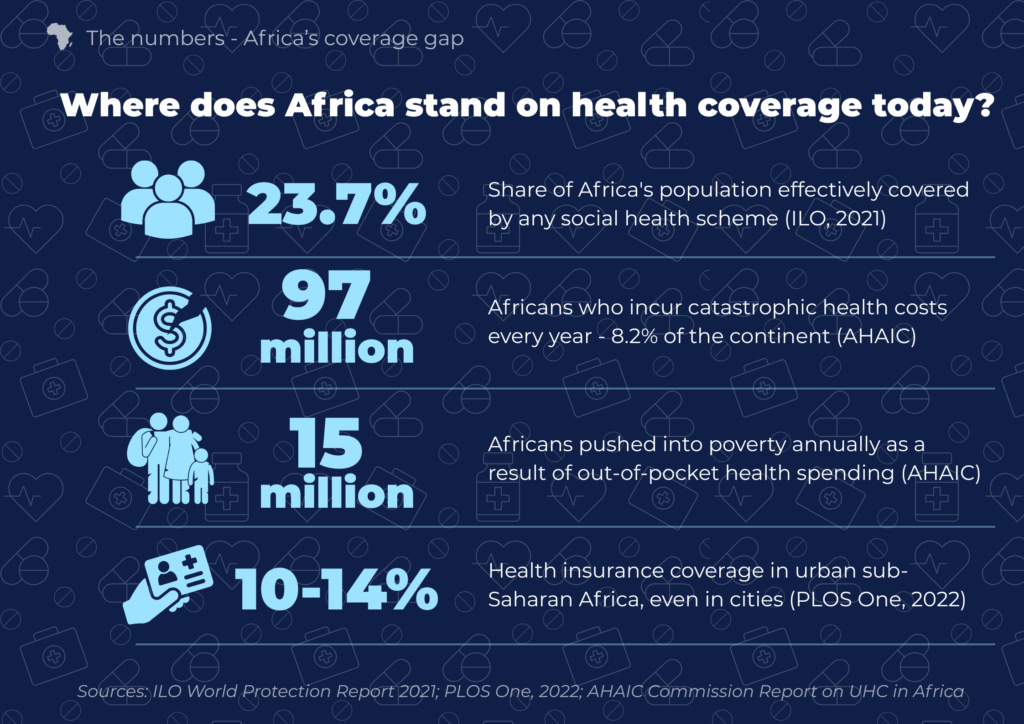
For decades, universal health coverage (UHC) has been one of Africa’s most ambitious development goals. Yet for millions of people, access to healthcare remains determined by their ability to pay. Today, more than 615 million people in Africa still lack access to basic health services, and many families continue to face financial hardship when seeking care. As fiscal pressures rise, foreign aid declines to its lowest ever, and health needs grow, the continent urgently needs sustainable domestic financing solutions.
In light of this, social health insurance has become a vital instrument for promoting UHC. Across the continent, governments are pursuing reforms to pool risks, reduce out-of-pocket spending, and create more sustainable financing for health services.
As promising as it sounds, what does it actually take to build a system that works for everyone, including the poorest and most vulnerable?
In this post, we explore what social health insurance is, why it matters, how it compares to alternative models, and what countries across the continent — including our partner countries — are doing to turn the promise of universal coverage into reality.
Three Models, One Goal
Countries across Africa are pursuing Universal Health Coverage through different insurance models. Each has its own logic , and its own limitations. Understanding the differences is critical to designing something that actually reaches everyone.
Dr. Mpuma Kamanga, Health Financing Manager (Anglophone Region), explains the models, tradeoffs, and success factors behind Social Health Insurance in Africa.
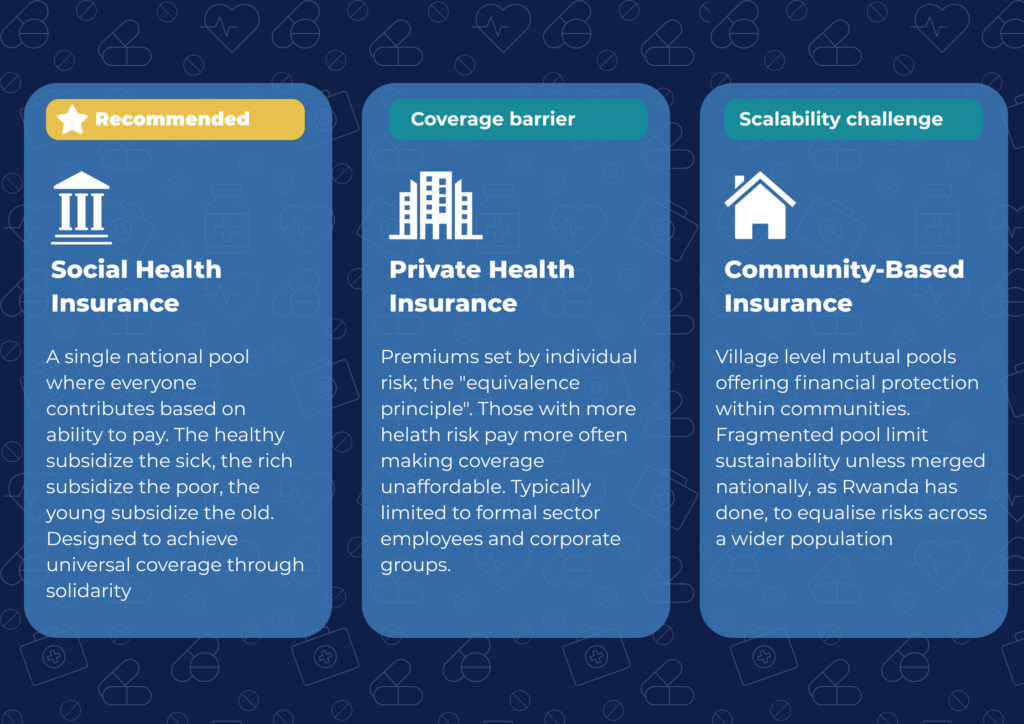
"In a private insurance scheme you use the equivalence principle — the individual is individually risk-rated. Your premium could be very high if you are found to be a risk factor, and you may not be able to afford it. That's why private health insurance schemes tend to be quite small — usually limited to small groups of company employees."
— Dr. Mpuma Kamanga, Health Financing Manager, Anglophone Region, Financing Alliance for Health
Why the Formal Sector Alone Won't Get You There
Social health insurance schemes that rely exclusively on formal payroll contributions face a fundamental problem in Africa: the formal sector is simply too small. Across the continent, the informal sector represents approximately 66% of the working population, and in some countries are as high as 80% of the working population work in the informal sector. Without explicit strategies to bring informal workers into the system through subsidies, community-based mechanisms, or diversified funding streams , coverage will remain concentrated among those already least likely to face financial hardship.
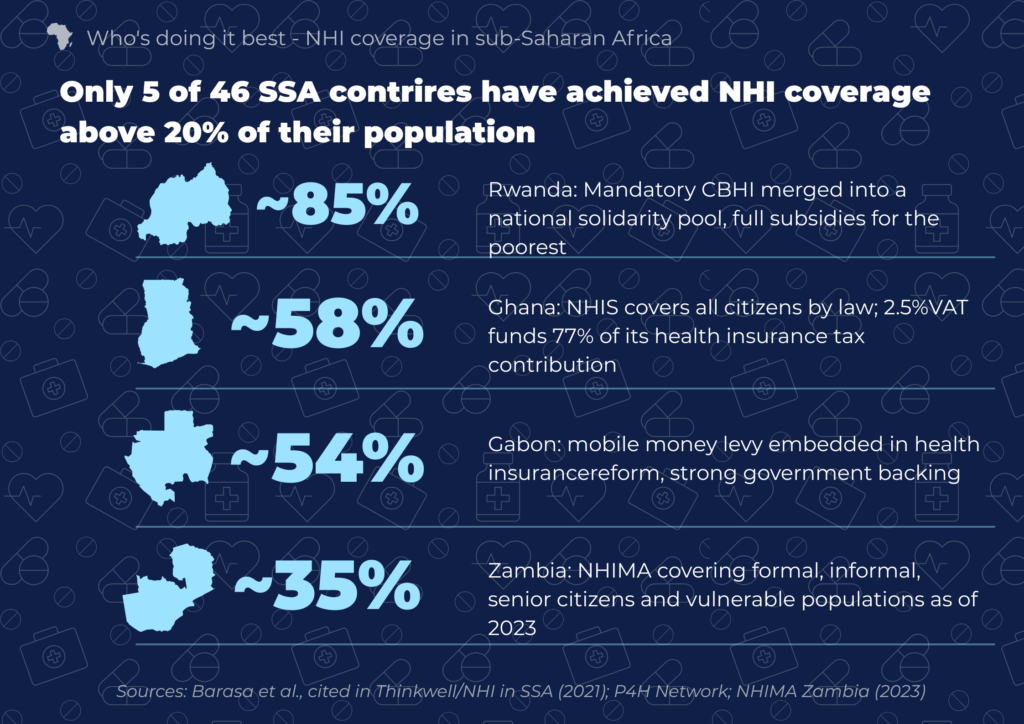
According to Health Financing Manager Anglophone, Dr.Mpuma Kamanga, this is why the most successful schemes on the continent have moved toward hybrid models: combining payroll contributions from tracked formal-sector workers with broader financing streams such as VAT levies, sin taxes on tobacco and alcohol, mobile money taxes, and direct government budget allocations to cover the poorest.
Beyond evaluating accessibility between the formal and informal sectors, what’s even more intricate and adds another level of complexity, is the question of how can countries can design social health insurance systems that are financially sustainable, equitable, and capable of improving health outcomes?
Evidence from across Africa shows that even where health insurance exists, health outcomes do not automatically improve unless financing reaches frontline services. Insurance schemes must be linked to well-funded primary healthcare systems, efficient public financial management, community health services, and strategic purchasing arrangements that reward performance and quality.
The countries making the greatest progress are not simply creating insurance schemes. They are building comprehensive health financing systems that connect insurance reforms with primary healthcare, community health, strategic purchasing, public financial management, and domestic resource mobilisation. This is where Financing Alliance for Health (FAH) has been partnering with governments—supporting them to move beyond coverage on paper toward financing systems that deliver real health outcomes.
Country Case Studies: FAH Partners in Action
The Financing Alliance for Health works across the continent to support countries designing and strengthening health financing systems. Each of our partner countries is at a different stage in their social health insurance journeys, but they all have valuable lessons.
Sierra Leone: Linking Insurance Reform to Service Delivery
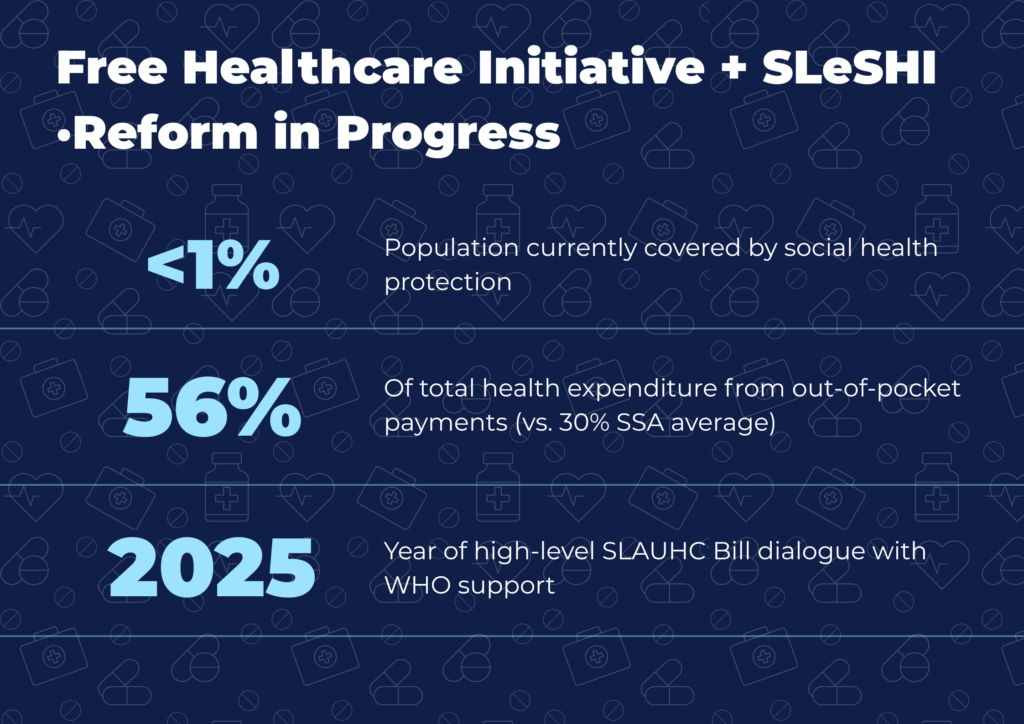
Sierra Leone’s journey to health financing reform is one of the most pressing on the continent. Despite a pioneering Free Healthcare Initiative (FHCI) launched in 2010 — which removed fees for pregnant women, children under five, and breastfeeding mothers — systemic financing gaps have persisted. With out-of-pocket spending at 56% of total health expenditure (nearly double the sub-Saharan average), the case for a national insurance scheme is urgent. In May 2025, with WHO support, the Ministry of Health convened a major policy dialogue on the draft Sierra Leone Agency for Universal Health Coverage (SLAUHC) Bill, which would unite the FHCI and the nascent Social Health Insurance Scheme (SLeSHI) under a single governance structure. Sierra Leone’s path illustrates a core insight: free-at-point-of-delivery care and insurance are not alternatives — they must work together for sustainable UHC.
FAH’s support has focused on ensuring that SLeSHI is not simply an enrolment mechanism, but a purchasing and financing platform that strengthens the health system. This includes work related to insurance scheme design, financing arrangements, implementation support, and integration with existing government priorities, including the Free Healthcare Policy.
The work recognises that successful insurance reforms depend on much more than collecting contributions. Sustainable schemes require clear benefit packages, effective purchasing arrangements, transparent claims systems, sound public financial management, and strong alignment between Ministries of Health and Finance. These are the building blocks that help ensure financing reaches frontline services and ultimately improves health outcomes.
Looking ahead, FAH’s strategic priorities in Sierra Leone include continued technical assistance for SLeSHI and support for integrating insurance reforms with broader universal health coverage and free healthcare policies. This reflects an important lesson emerging across Africa: successful social health insurance reforms are strongest when they are embedded within wider health financing and primary healthcare reforms rather than operating as parallel systems.
Sierra Leone’s experience highlights an important lesson for many African countries: insurance reforms are most impactful when they are integrated into broader UHC strategies that address financing, service delivery, and equity simultaneously.
Kenya: Building an Integrated Health Financing Architecture
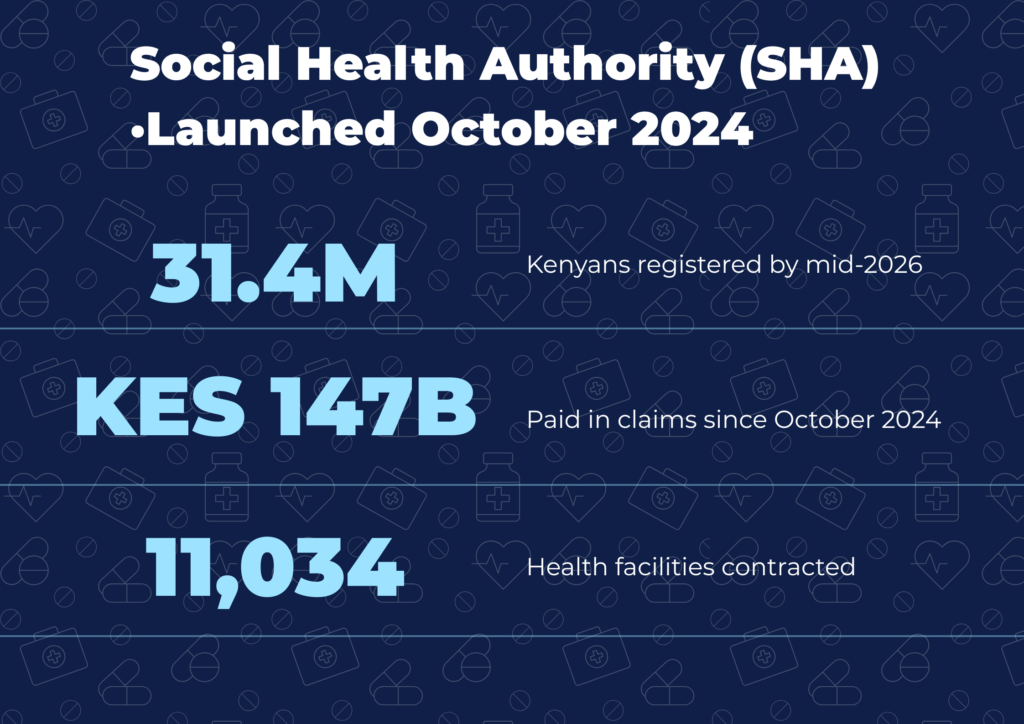
In October 2024, Kenya replaced the National Hospital Insurance Fund (NHIF) with the Social Health Authority (SHA) — the most ambitious health financing reform in the country’s history.
This created three financing mechanisms:
- The Primary Healthcare Fund
- The Social Health Insurance Fund
- The Emergency, Chronic and Critical Illness Fund
Contributions are set at 2.75% of gross income (employee and employer each), with a minimum of KES 300/month for informal sector workers. Over 1.16 million safe deliveries have been financed since launch. Together, these reforms aim to strengthen risk pooling, improve financial protection, and expand access to healthcare services.
Importantly, Kenya’s insurance reforms are not operating in isolation. They are reinforced by complementary legislation including the Primary Health Care Act, the Facility Improvement Financing Act, and the Digital Health Act. These reforms collectively seek to strengthen how healthcare is financed, delivered, and managed.
The scale of investment is significant. Kenya has allocated approximately KES 60.5 billion toward health financing reforms over the FY 2022/23–2027/28 period, with 89% coming from domestic resources and only 11% from external partners.
The reform reflects a key principle Dr. Kamanga highlights: combining contributory and non-contributory streams, with the government subsidising the most vulnerable. The challenge ahead is activating the estimated 24 million registered but non-contributing members — a test of whether the solidarity model can truly reach the informal sector at scale.
This reflects an increasingly important principle for countries across the continent: sustainable health coverage requires sustainable domestic financing.
Zambia: Making Every Health Dollar Count
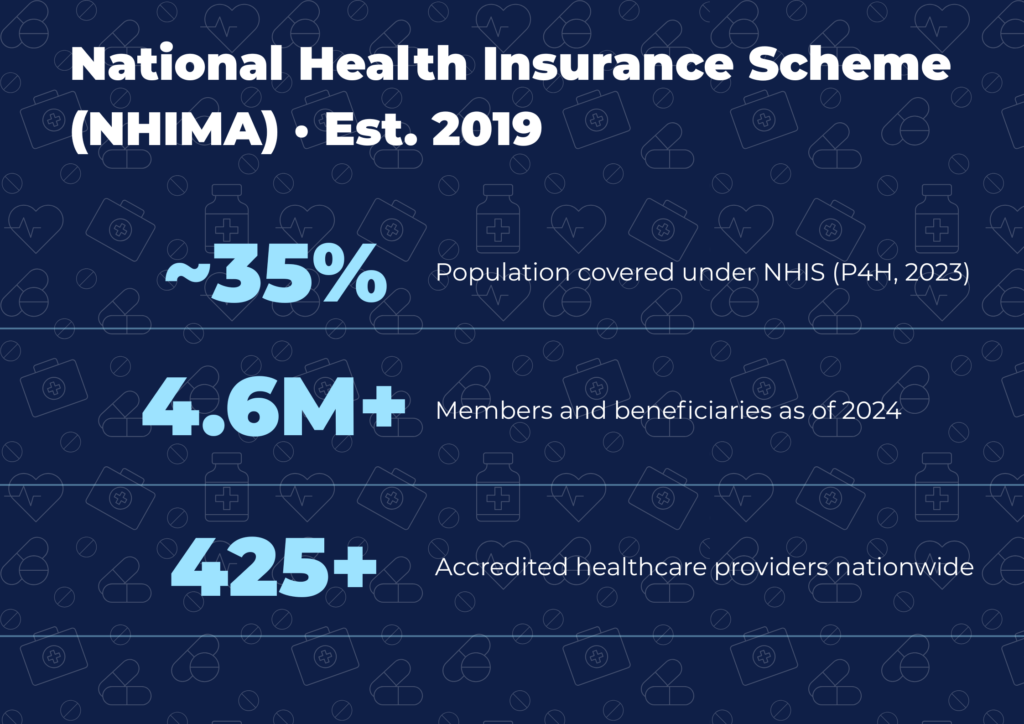
Zambia passed its National Health Insurance Act in 2018 and launched NHIMA in 2019, making it one of the newer national schemes on the continent. In just five years, it has grown to cover formal employees, senior citizens, the vulnerable, and is actively expanding to the informal sector. Contributions are set at 1% of monthly salary, matched by employers , with an average of KES 50 Kwacha/month for a family of seven, one of the most affordable on the continent. The scheme has invested in digital infrastructure for claims processing, deployed mobile registration teams in rural areas, and piloted Global Fund-supported coverage for 16,000 poor households.
One of the key challenges facing Zambia is the large informal sector, which accounts for more than 83% of the labour force. While NHIMA has made substantial progress, enrolling approximately 4.6 million members, equivalent to around 23% of the population, expanding coverage among informal workers remains critical to achieving universal health coverage.
FAH’s work has focused on helping government address these implementation challenges. Through policy development, technical assistance, health financing analysis, and embedded government fellowships, FAH has supported reforms aimed at strengthening NHIMA’s coverage, efficiency, accountability, and long-term sustainability.
A notable contribution has been FAH’s collaboration with the Ministry of Health and NHIMA to identify barriers preventing Zambia’s more than 90,000 Community-Based Volunteers (CBVs) from supporting NHIS expansion. The resulting policy work provided practical recommendations for integrating community health structures into insurance enrolment and outreach efforts, creating a pathway for extending coverage into underserved communities.
FAH has also supported the development of Zambia’s Primary Health Care Strategy (2025–2031), including work to define comprehensive PHC service packages and financing arrangements. This has helped align health insurance reforms with broader health system goals, ensuring that coverage expansion is accompanied by stronger primary healthcare services and more sustainable financing arrangements.
Beyond insurance design, FAH provided embedded technical assistance for Zambia’s National Health Accounts and the National Health Compact, improving visibility of financing flows and strengthening the evidence base needed to make informed decisions about health financing and resource allocation
A New Vision for Universal Health Coverage
The next generation of social health insurance reforms in Africa will need to go beyond coverage cards and contribution mechanisms.
They will need to finance stronger systems.
Sustainable progress towards UHC happens when health financing reforms are integrated, government-led, and focused on results.
As countries navigate tightening fiscal space and growing healthcare needs, social health insurance will remain an important tool. But its true value will lie not in how much money it raises, but in how effectively it helps governments build resilient, equitable, and people-centred health systems that leave no one behind