When conversations about financing are had, they often focus on one question: do we have enough money? But perhaps the more important question is this: are we spending available resources in the right places?
The Zambia National Health Accounts (2022–2024) provide an important picture of how resources are flowing through the country’s health system and what this means for the future of healthcare delivery. The reports show a strong investment in PHC, reduced household out-of-pocket spending, and continued RMNCAH-N financing. However, these gains are threatened by declining ODA funding cuts, exchange-rate depreciation, debt pressures, weak budget execution, and continued dependence on external financing for HIV, TB, malaria and other priority programmes.
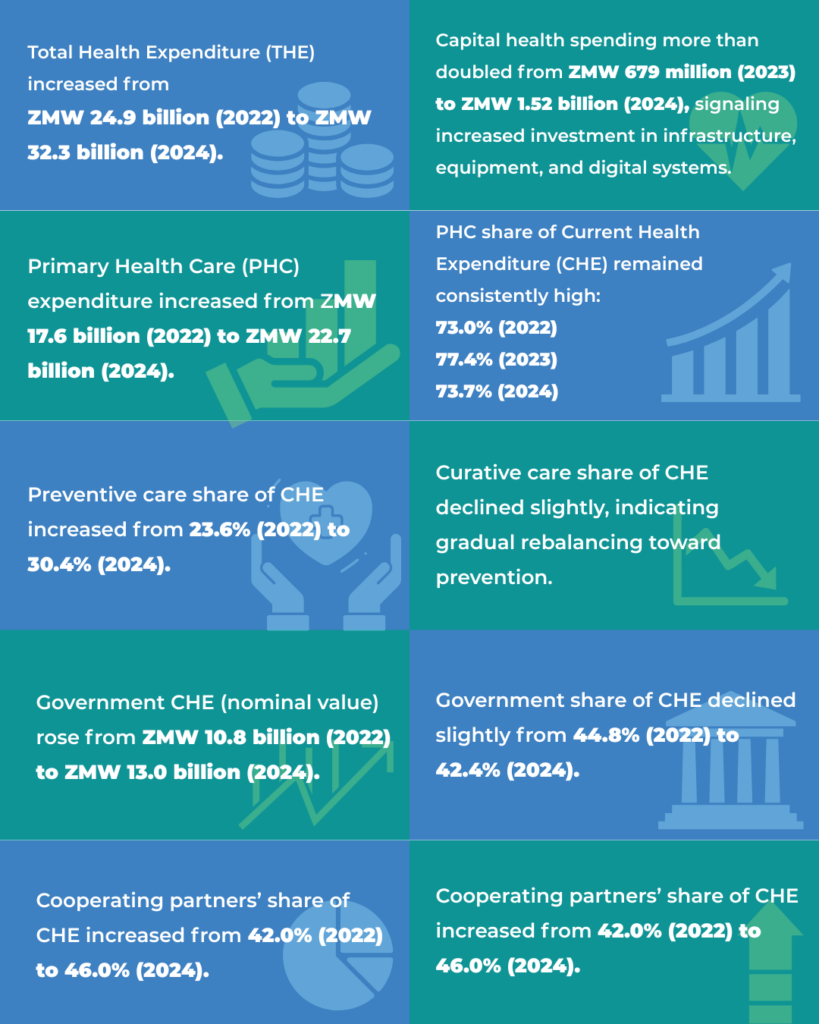
The report shows that Zambia’s total Current Health Expenditure (CHE) increased significantly over the three-year period, rising 27.8% from ZMW 24.1 billion in 2022 to ZMW 30.8 billion in 2024 with Current Health Expenditure accounting for over 95% of total spending. This reflects continued investment in the health sector at a time when the country is facing growing health demands, population pressures, disease outbreaks, and economic challenges., However, Current Health Expenditure per capita declined from US$72.38 in 2022 to US$55.58 in 2024 in real terms, showing that inflation and Kwacha depreciation were reducing the real purchasing power of health resources, especially for imported medicines, diagnostics, vaccines, equipment and supplies
But the report also reveals a deeper story about where health financing comes from and how dependent the system remains on external support.
Government remains a major financier, contributing around 42–47% of Current Health Expenditure. In 2024, donor financing rose to about 46% of Current Health Expenditure, confirming that Zambia’s health sector remains highly exposed to external financing shocks. This is especially concerning in light of recent ODA and USG funding cuts, which could affect HIV, TB, malaria, immunisation, RMNCAH-N, commodities, supply chains, data systems and NGO-supported service delivery platforms.
These findings highlights both progress and vulnerability. On one hand, increased investment has supported service delivery and strengthened healthcare access. On the other, the health sector remains heavily reliant on external financing, raising important questions about long-term sustainability and resilience.
The NHA also shows some positive progress in financial protection. Household out-of-pocket spending declined from 11.17% of Current Health Expenditure in 2022 to 9.25% in 2024, reducing financial pressure for many families when seeking care. While the figures suggests some improvement in pooled financing and protection of households, it should be interpreted cautiously because they are based on projections from the 2022 Living Conditions Monitoring Survey rather than a dedicated household health expenditure survey. The report suggests that the growing operationalization of the National Health Insurance Scheme (NHIS) may already be helping reduce direct household spending on healthcare.
The data also shows a gradual expansion of social health insurance contributions, reflecting efforts to strengthen more sustainable financing mechanisms. While still relatively small compared to government and donor funding, this signals an important shift toward broader financial protection for the population.
Zambia remains below the Abuja Declaration target of allocating at least 15% of government expenditure to health. Government Current Health Expenditure as a share of General Government Expenditure declined from 8.18% in 2022 to 6.88% in 2024. Given debt pressures, inflation, exchange-rate volatility and competing national priorities, the health sector must make a stronger case for more predictable, better prioritised and better executed domestic financing, rather than simply asking for larger allocations.
Where the money went
Hospitals continue to consume the largest share of health expenditure, accounting for nearly 40% of spending in 2024. At the same time, spending on ambulatory and primary care services declined over the period, while investment in preventive care increased significantly.
This shift toward prevention is particularly important. Preventive services, including vaccination campaigns, disease surveillance, health promotion, testing, and early detection programmes, rose from 23.6% of total health expenditure in 2022 to over 30% in 2024. These investments reflect lessons learned from public health emergencies such as COVID-19 and Mpox, reinforcing the importance of preparedness and community-level prevention.
The report also points to growing domestic capacity for specialized healthcare. Spending on treatment abroad remained very low, likely reflecting investments in facilities such as the National Heart Hospital and specialized cancer treatment centres within Zambia. This represents an important step toward reducing costly overseas referrals while improving access to advanced care locally.
Budget execution remains one of the biggest hidden financing gaps. Government disbursed, on average, only 75.3% of the approved Ministry of Health budget between 2022 and 2024. Disbursement fell from 84.7% in 2022 to 66.2% in 2023, before improving to 72.4% in 2024. In a period of aid cuts, Zambia cannot afford approved budgets that are not fully released or are released late. Weak execution leads to delayed procurement, medicine stock-outs, unpaid suppliers, disrupted outreach, weak supervision and poor district-level service delivery.
PHC remains Zambia’s strongest health financing story. PHC expenditure increased from ZMW 17.6 billion in 2022 to ZMW 22.7 billion in 2024, representing about 73–77% of Current Health Expenditure. This should be protected as the foundation of Universal Health Coverage.
RMNCAH-N spending also increased from ZMW 3.2 billion in 2022 to ZMW 4.5 billion in 2024, but its share declined from 16.6% in 2023 to 14.7% in 2024, suggesting that RMNCAH-N did not keep pace with overall health spending growth in 2024.
Policy priorities
Zambia should urgently develop a health financing transition plan for ODA and USG cuts; protect PHC, RMNCAH-N, commodities and community health in the 2026 budget and MTEF; use the Abuja Declaration as a medium-term budget negotiation framework; strengthen domestic revenue mobilisation and NHIMA strategic purchasing; improve budget releases and PFM systems; reduce wastage and leakage in procurement and medicines; and use NHA evidence more systematically in MoH–MoF budget dialogue, donor coordination and Global Fund co-financing discussions.
The NHA 2022-2024 confirms that Zambia has made progress, but the financing model remains fragile. The next phase of reform must focus on domestic resource mobilisation, prioritisation, stronger PFM, better budget execution, and protection of PHC and RMNCAH-N as the foundation of a resilient and sustainable health system.
The Financing Alliance for Health will continue supporting the Government strengthening and sustaining the gains thus far achieved in the health financing space.
SOURCE OF INFO MOH ZAMBIA NATIONAL HEALTH ACCOUNTS