By Nji Valery Che & Maya Hayakawa
Sierra Leone is at a defining moment for its health system as the country continues it journey toward Universal Health Coverage (UHC). Ensuring effective and sustainable health financing has become more crucial today than ever before.
Who pays for healthcare, and at what cost to households?
For years, Sierra Leone has made important progress expanding access to essential health services. But beneath these gains lies a fragile financing reality: households continue to shoulder a heavy share of healthcare costs, donor funding remains critical but uncertain, and public financing is stretched by limited fiscal space. Without reform, this imbalance risks undermining the country’s ambition to achieve Universal Health Coverage (UHC).1
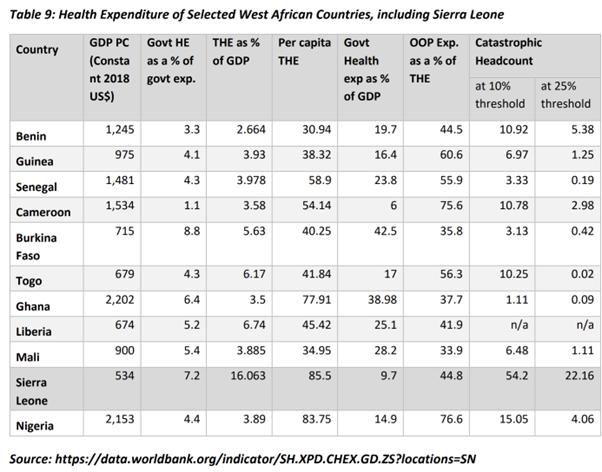
Government analysis shows that households remain the largest single source of health financing in the country. Outofpocket payments account for 44.8% of total health expenditure, meaning that nearly half of all health spending comes directly from people paying at the point of care rather than through pooled public funds. 2
At the same time, government health spending remains limited. Public health expenditure represents 9.7% of Gross Domestic Product (GDP). While this contribution is commendable, it is not yet sufficient to provide comprehensive financial protection or sustainably fund essential services nationwide.
Development partners continue to play a vital role in keeping the system functioning. According to government data, development partners contribute approximately 22.2% of total health expenditure, helping to finance key programs and services. However, this reliance also raises important sustainability concerns, particularly as global health funding becomes more uncertain. Currently, funding for health comes from multiple sources government budgets, development partners, and vertical programs which often operate independently. This fragmentation can lead to inefficiencies and limit the system’s ability to allocate resources where they are most needed.
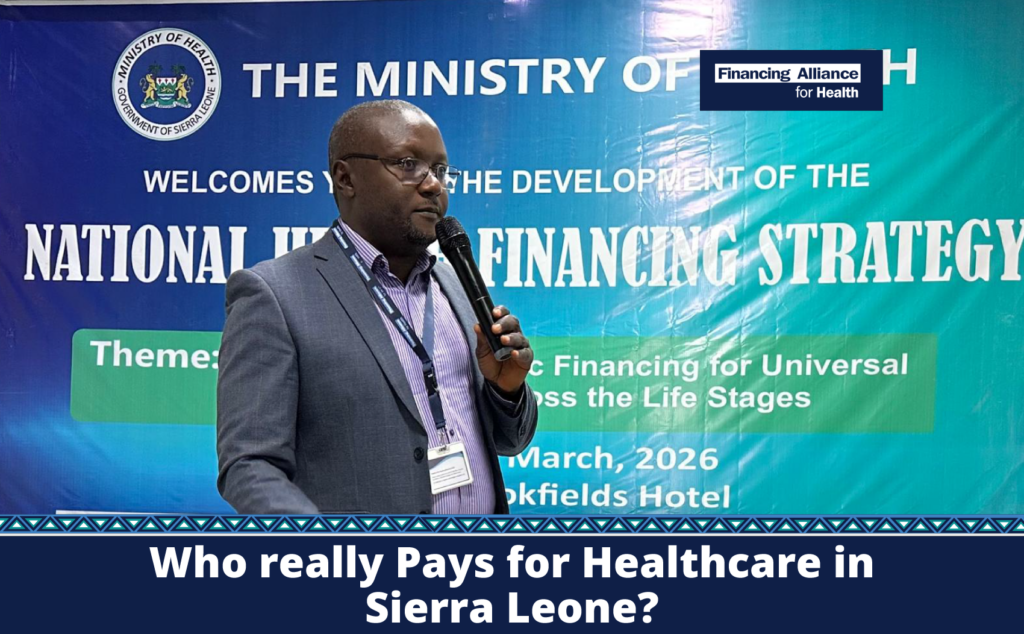
It is against this backdrop that the Government of Sierra Leone is developing the National Health Financing Strategy (NHFS) 2026–2030 a roadmap that will shape how health services are funded, organized, and delivered over the next five years. The Ministry has actively inviting a broad spectrum of stakeholders to participate in the process, ensuring input from diverse perspectives; including the Office of the Vice President, the Ministry of Finance, the Parliamentary Committee on Health, development partners, district medical officers, and institutions such as the National Revenue Authority, National Social Security and Insurance Trust (NASSIT), National Emergency Medical Service Agency (NEMSA), World Bank, World Health Organization (WHO) as well as civil society organizations. This inclusive approach reflects the Ministry’s commitment to shaping a strategy that meets the needs and priorities of all sectors involved in Sierra Leone’s health system.
During the workshops focused on strategy development, it was noted that the health sector continues to confront significant obstacles, including insufficient funding, reliance on donors, and suboptimal resource allocation. Addressing these challenges is essential to implementing effective health financing reforms and achieving improved outcomes.
Four Reform priorities shaping the National Health Financing Strategy 2026–2030 that will change everything
The National Health Financing Strategy (NHFS) 2026–2030 is being developed at a time of profound transition for Sierra Leone’s health system. As the country advances toward universal health coverage, a set of critical health financing reforms and priority areas have emerged as central to improving service delivery, strengthening financial protection, and advancing equity in access to care.
These priorities reflect a growing consensus that how health services are financed is as important as how they are delivered. Together, they will form the strategic foundation of the NHFS over the next five years.
1.Strengthening domestic financing for health
Increasing domestic financing is a central priority for the future of Sierra Leone’s health system. Expanding public investment in health is essential to reduce reliance on outofpocket payments and external assistance, while ensuring predictable and sustainable funding for essential services. Stronger domestic financing will be critical to supporting priority health reforms and maintaining continuity of care, particularly at the primary and community levels.
2. Improving pooling to reduce fragmentation and promote equity
Health financing in Sierra Leone currently flows through multiple channels, including government budgets, development partners, and vertical programmes. Strengthening pooling mechanisms is therefore a key reform area, enabling better integration of domestic and external resources. More effective pooling will allow resources to be redistributed across districts based on need, helping to reduce regional disparities and ensure that poorer and underserved communities are not left behind.
3. Advancing strategic purchasing to improve service delivery
Improving efficiency and impact requires not only more resources, but smarter use of available funds. Strengthening strategic purchasing is a priority area for reform, ensuring that health spending is aligned with national priorities, population needs, and performance. By linking financing more closely to results, strategic purchasing can enhance accountability, improve quality of care, and drive better health outcomes across the system.
4. Establishing a coherent national health benefit package
A unified national health benefit package is a cornerstone of equitable and peoplecentred health financing. The NHFS will be informed by efforts to define a benefit package focused on highimpact interventions across all life stages, financed through public funds and delivered free at the point of care. Such a package is essential to guaranteeing access to essential services while protecting households from catastrophic health expenditures.
Designing a system that works for everyone
Taken together, these reform priorities reflect a broader ambition: to build a health financing system that supports effective service delivery, financial protection, and equity. The NHFS is being designed to align health financing reforms with wider sector initiatives, including primary health care strengthening, social health insurance reforms such as SLeSHI, and performancebased approaches to funding care.
By ensuring coherence across these areas, the strategy aims to translate financing reforms into tangible improvements at the frontline — where health workers deliver care and communities experience the health system.
What’s Next?
The development of the National Health Financing Strategy 2026–2030 marks an important step in Sierra Leone’s longterm health reform agenda. The priorities outlined above will guide the refinement of the health financing framework and inform the design of a strategy that is both technically sound and nationally owned.
As Sierra Leone continues its pursuit of universal health coverage, the success of the NHFS will depend on sustained leadership, coordinated action across sectors, and a shared commitment to equity. By aligning resources, strengthening governance, and focusing on financial protection, the National Health Financing Strategy has the potential to fundamentally reshape how health services are financed — and to improve the health and wellbeing of all Sierra Leoneans.
Connecting the dots: Wider health reforms
Crucially, the NHFS is not being developed in isolation. It is the financing glue that will hold together Sierra Leone’s wider reform agenda — including the scaleup of the National Social Health Insurance Scheme (SLeSHI) and ongoing efforts to strengthen performancebased financing and primary health care.
By providing a clear financing framework, the NHFS will help ensure that reforms like SLeSHI are not standalone initiatives, but part of a coherent system that expands coverage, improves financial protection, and delivers value for money.
Looking ahead
The consultative workshop marked a critical milestone. Insights from the discussions will inform the refinement of the diagnostics and guide the drafting of the National Health Financing Strategy 2026–2030, with a first draft expected by the end of March 2026.
The stakes are high. Done right, the NHFS will redefine who pays for healthcare in Sierra Leone — and who is protected when illness strikes. It will determine whether progress toward UHC accelerates or stalls.