Dr Krishna Jafa – Interim CEO the Missing Billion Initiative (MBI)
This International Women’s Day/month, the Financing Alliance for Health (FAH) is spotlighting female-led organizations advancing gender equality under our campaign theme “Fund Her Frontline: Financing Primary Health Care for Women’s Health & Leadership,” aligned with the global call to #givetogain.
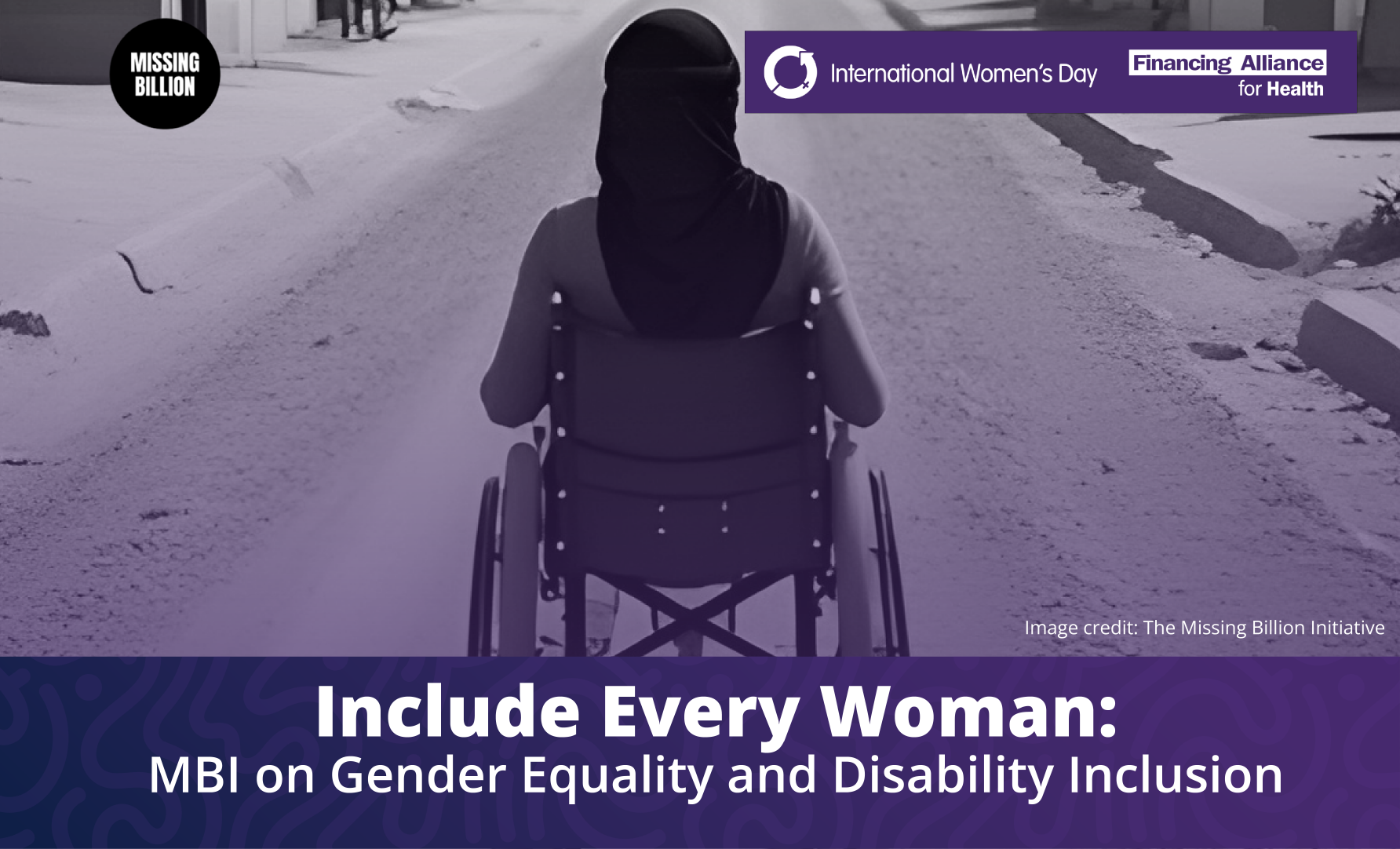
One of the organizations featured is The Missing Billion Initiative (MBI), led by Dr. Krishna Jafa, Interim CEO. MBI is a global movement working to close the severe health inequities experienced by the 1.3 billion people living with disabilities — inequities that too often remain invisible in mainstream programming and policy.
In an exclusive sit-down with the Financing Alliance for Health, Dr. Krishna Jafa shares her vision of what it truly means to accelerate progress. She makes a compelling case for why disability inclusion must be woven into gender equality initiatives from the very start.
Dr. Krishna Jafa emphasises that health, gender, and society are deeply intertwined—none can be separated from the others. She highlights that true progress demands recognising those who have been rendered invisible by mainstream systems and ensuring they are brought to the forefront and included in every aspect of our world. Her vision urges us to acknowledge that inclusive change is not optional, but fundamental to building just and equitable communities.
Her insights challenge us all to rethink what inclusive change looks like.
1. Advancing Gender Equality:
This year’s global International Women’s Day theme is Give to Gain, focusing on driving gender equality through intentional, collective action, investment, and support. From your perspective, what does accelerating action look like in your work, and why is this urgent now? Beyond the health sector, how is your work contributing to broader gender equality and social change in communities and across society?
Women with disabilities experience compounded inequities, as women and as persons with disabilities. Our research shows persistent gaps in access to sexual and reproductive health, maternal care, preventive services, and respectful treatment within health systems. Yet these gaps remain largely invisible in mainstream gender and health programming.
At MBI, accelerating action means three things:
First, building and translating the evidence. We produced the first global review of health systems for women with disabilities because you cannot fix what you do not measure. Gender equality efforts that do not include disability are incomplete by design.
Second, shifting how health systems are structured. We focus on healthcare workers, the first touchpoint in the system, because inclusive training, facility audits, and system-level assessments change how care is delivered in practice.
Third, positioning disability inclusion within global gender and health conversations, not as a niche issue, but as a core equity priority.
This is urgent now because global commitments to universal health coverage and gender equality will fail if 1.3 billion people, including millions of women and girls with disabilities, remain excluded. Inclusion is not an add-on; it is a test of whether equity commitments are real.
Beyond health, our work contributes to broader gender equality by challenging structural invisibility. When women with disabilities are counted in data, reflected in policy, and visible in global forums, that shifts norms across society, not just in clinics.
2. Funding Women at the Frontline:
MBI advocates for health systems that work for everyone. How is your organization influencing global partners and governments to invest more effectively in primary health care for women with disabilities, and what are the most critical financing gaps your research has identified?
MBI’s advocacy for inclusive primary health care is grounded in rigorous evidence that highlights where financing is most deficient, especially for women with disabilities and what partners and governments must address to close those gaps.
1) Underinvestment in Disability-Inclusive Health Overall
Our funding analysis shows a stark reality: only 0.4 % of global development assistance for health was allocated to making health services disability-inclusive between 2013 and 2022. This means that despite 1.3 billion people living with disabilities globally, disability inclusion, including for women, receives a minuscule share of the global health financing portfolio.
2) Structural Gaps in Data and Financing
MBI’s research with the McKinsey Health Institute underscores the lack of basic health data infrastructure: in a 2023 review across 188 countries, 63 countries had no functional-difficulty questions in their disability data systems. Without routine disability-disaggregated data, health budgets and financing mechanisms cannot be aligned to actual needs.
3) Gender Disparities in Health Outcomes and Financing
Our gender-focused work documented profound inequities for women with disabilities:
- Women with disabilities represent an estimated 18 % of all women globally (~700 million), yet face worse health outcomes than women without disabilities, including 10-20 years lower life expectancy.World Health Organization Global Report on Health Equity for Persons with Disabilities (2022).
- Women with disabilities represent an estimated 18 % of all women globally (~700 million), yet face worse health outcomes than women without disabilities, including 10-20 years lower life expectancy.World Health Organization Global Report on Health Equity for Persons with Disabilities (2022).
- Evidence from academic analyses shows that disabled women are significantly more likely to experience adverse maternity-related outcomes such as 44 % higher odds of stillbirth or neonatal mortality, 30–69 % higher odds of caesarean birth, 35–70 % lower odds of breastfeeding, and 51–111 % higher odds of extended postnatal hospital stays.
- Evidence from academic analyses shows that disabled women are significantly more likely to experience adverse maternity-related outcomes such as 44 % higher odds of stillbirth or neonatal mortality, 30–69 % higher odds of caesarean birth, 35–70 % lower odds of breastfeeding, and 51–111 % higher odds of extended postnatal hospital stays.
These numbers show not only gaps in care quality but also where financing must be directed, e.g., maternal and reproductive health programmes designed for inclusivity.
4) Missed Investments in Inclusive Service Delivery
People with disabilities, including women, face disproportionate barriers to basic healthcare: mortality rates and outcomes are demonstrably worse (e.g., three times higher mortality from certain conditions) and 50 % more likely to experience catastrophic health spending. Yet current health financing frameworks do not adequately allocate for accessibility features, inclusive workforce training, or data systems that would enable tracking of these inequities.
Why These Gaps Matter for Women With Disabilities
The financing gaps highlighted above, particularly the low proportion of inclusive funding and the absence of robust disaggregated data, limit governments’ and partners’ ability to plan, budget, and prioritise services that reach women with disabilities at the frontline of care.
By providing specific benchmarks and numbers from MBI-led research, we can help partners and governments target investments where they are most needed, from disability-inclusive primary care and maternal health services to health workforce capacity building and data systems strengthening.
3. Women as Leaders:
Women make up the majority of the health workforce yet remain underrepresented in leadership and decision-making. How is your organization supporting women to move from the frontline into leadership and influence?
Women constitute the majority of the global health workforce, yet leadership at the highest levels still does not reflect that reality.
At MBI, we see leadership not simply as representation, but as influence over decisions that shape systems. Our governance reflects that commitment. Our Founders Board is fully female, and across our leadership and team, many bring lived experience of disability. Our Interim CEO, Dr. Krishna Jafa, leads the organisation at a moment where inclusive health systems are increasingly recognised as central to global health equity.
We are also intentional about creating space for leaders with disabilities in global decision-making arenas. In 2025 and again in 2026, MBI is convening a Disability & Inclusion Leadership Cohort to the Skoll World Forum, eight leaders with diverse disabilities, supported to participate fully and meaningfully.
They join these spaces as experts and contributors, shaping conversations on health, equity, and systems reform. For us, supporting women’s leadership means ensuring that those most affected by inequities are present where priorities are set, funding is directed, and ideas are debated.
4. A Message to the World:
On International Women’s Day, what is your message to governments, partners, and the global community about accelerating action for gender equality and investing in women’s leadership and health? And what is your message specifically to young women and girls aspiring to lead change in health and beyond?
Advancing gender equality requires that we widen our lens. Women with disabilities continue to face systemic barriers across health systems, in access, in financing, and in leadership. If we are committed to equity, disability inclusion must be meaningfully integrated into health policies, financing strategies, workforce investments, and global commitments.
This means ensuring women with disabilities are visible in data, reflected in programme design, and represented in decision-making spaces. Investments in women’s health are strongest when they are accessible and inclusive by design. When accessibility is built in from the start, health systems become stronger for everyone.
Gender equality and disability inclusion are not parallel agendas, they are deeply interconnected. Progress in one reinforces progress in the other.
To Young Women and Girls Aspiring to Lead:
“Your lived experience is a source of insight and strength. Whether you are working in research, policy, frontline care, advocacy, or community leadership, your perspective matters in shaping systems that are fairer and more inclusive.
Leadership does not look one way. It grows in communities, in classrooms, in clinics, and in movements. We also have a responsibility to ensure that pathways to leadership are open, accessible, and supportive.
Advancing gender equality requires courage, collaboration, and persistence. The future of health and social change will be shaped by women who step forward, and by systems that recognize their value and create space for their leadership.”

About The Missing Billion Initiative (MBI)
The Missing Billion Initiative is a global movement working to address the severe health inequities faced by the 1.3 billion people worldwide living with disabilities — closing gaps in healthcare access, outcomes, and the data systems that too often render disability invisible.
Learn more: www.themissingbillion.org
MBI is also part of the Financing Alliance for Health’s fiscally sponsored projects, supported through FAH’s fiscal sponsorship program