By Soleine Scotney – Co Chief Executive Officer
Women hold up the sky, but in Africa, they also hold up the entire health system.
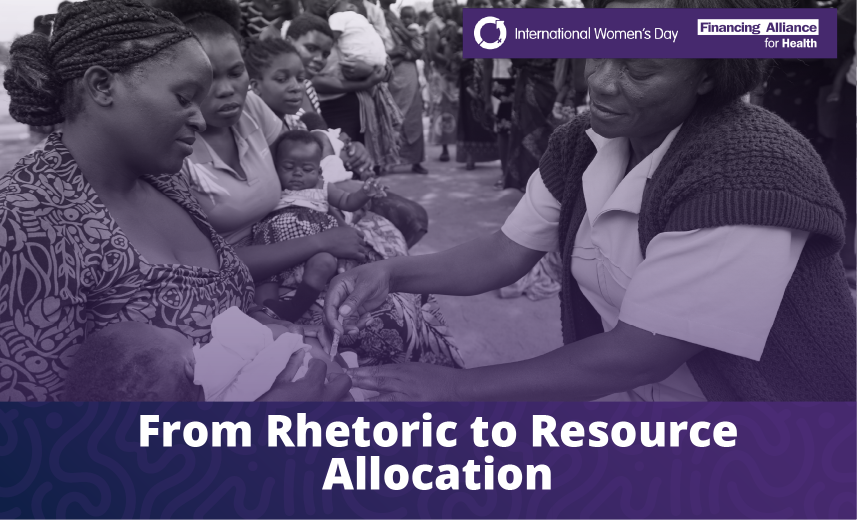
They show up as Community Health Workers (CHWs) trekking the last mile. They show up as nurses working double shifts. They show up as mothers, the “Chief Logistics Officers” of family health, navigating systems that weren’t built with them in mind.
But here is the invisible crisis: Women are the engine of global health, yet they are almost entirely absent from the fuel gauge: the budget.
The $1 Trillion “Hidden Tax”
We often talk about the “gender gap” as a social justice issue. But recent data from the World Economic Forum and McKinsey reveals a much more clinical truth: The women’s health gap is a $1 trillion opportunity.
Globally, women spend 25% more of their lives in poor health compared to men. In Africa, this isn’t just a health statistic; it’s a massive “hidden tax” on our GDP. When a woman in Kenya or Senegal spends nine years of her life in sub-optimal health because of underfunded reproductive care or uncompensated labor, our entire economy loses its pulse.
We say we value women. We wear the ribbons and attend the breakfasts. But the reality is that only 4% of global health R&D specifically targets women’s health.
This is not a gender issue. It is a financing failure.
The engine without oil
Imagine a high-performance engine. In Africa, women make up nearly 70% of the health workforce, yet they hold only 25% of the senior leadership roles. We are asking the engine to run at full speed while denying it the oil it needs to function – the funding, the payroll, and the decision-making power.
This International Women’s Day, at the Financing Alliance for Health, we aren’t asking if you value women. We are asking: Are you funding the systems women depend on?
When we leave CHWs off the payroll, we aren’t “saving money.” We are predatory on women’s time. When we fail to track gender in our expenditures, we are flying blind.
The Turning Point: Three bold commitments
At Financing Alliance for Health, we are helping Ministries of Health and Ministries of Finance across Africa move beyond the “celebration” of IWD and commit to three structural shifts:
- De-segregate budget negotiations: We need women in the rooms where the money moves—in budget negotiations, procurement committees, and purchasing reforms. If a woman isn’t at the table during a budget cycle, the “frontline” is invisible.
- Audit the equity: Adopt gender-expenditure tracking. If you don’t measure where the money goes, it won’t help address the women health gap.
- Professionalize the Frontline: Stop treating Community Health Workers – of which 70% of women- like volunteers. Put them on the payroll and develop supporting systems that allow them to deliver full health impact: this includes clear empanelment of vulnerable households, an ambitious yet realistic list of health services to be provided, stock quantification and supply chains which reach the last mile, data systems that function as job aids, track performance and identify where support is needed. This is the single most effective way to improve Universal Health Coverage (UHC) and national health security.
IWD is not a one-day affair; let’s make it the day we stop praising the frontline and start funding it.
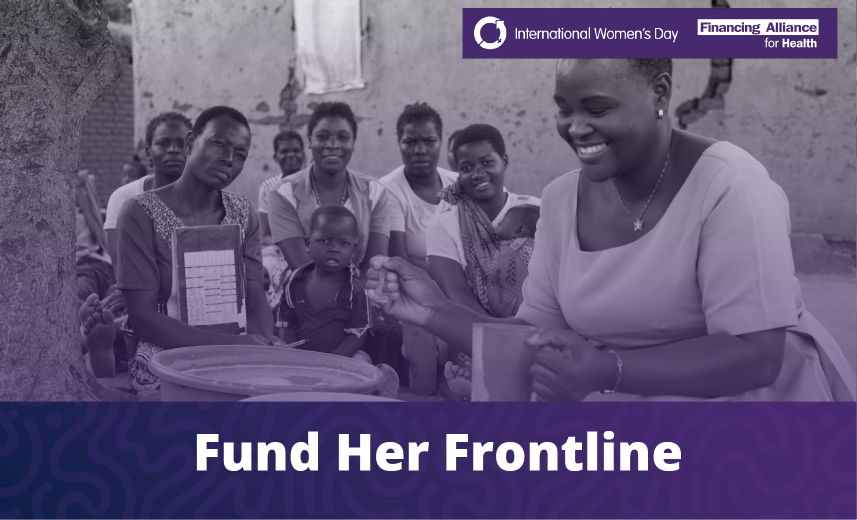
Fund her frontline. For women. For families. For the future of Africa.
Happy International Women’s Day.