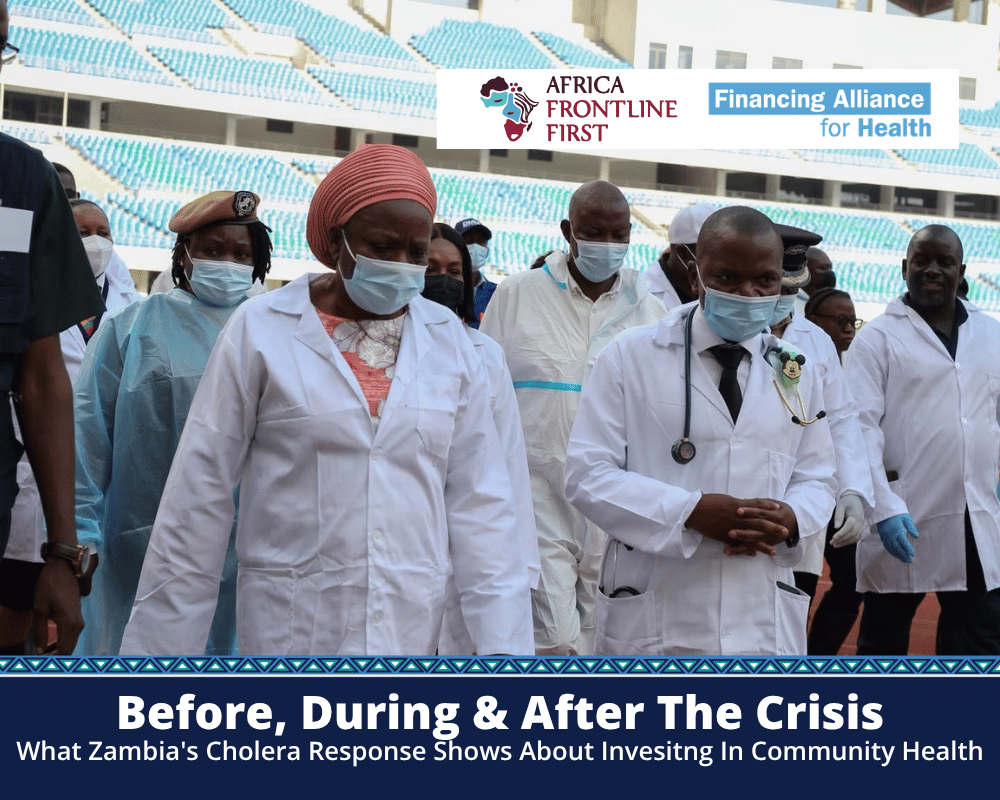
Violet Chizema is one of the longest-serving Community-Based Volunteers (CBVs) in Lusaka. When cholera spread through the city in late 2023, she spent her days going door to door, helping families understand how to prevent the disease. “We worked tirelessly,” she says. “Some days we were in the field from morning till late, and sometimes even helped clean the health facility and support patient care.”
Violet was one of hundreds of volunteers who stepped forward during the crisis. They taught households about hygiene and safe water, distributed chlorine, checked water sources, and referred suspected cases to health facilities for treatment. Some worked inside hospitals too, cleaning triage areas, mopping wards, and chlorinating surfaces late into the night.
A Health System Under Pressure
In October 2023, Zambia faced its deadliest cholera outbreak in recent history. It began in Kanyama, one of Lusaka’s most crowded townships, with more than 562,000 residents, and spread across the capital and beyond. By April 2024, more than 22,000 cases and over 700 deaths had been reported nationwide. Rapid urban growth, densely packed informal settlements, poor sanitation, and limited access to clean water all contributed to the spread.
Health facilities were stretched to their limits. “At the peak of the outbreak, we were receiving between 130 and 160 patients every 24 hours,” says Benson Chisenga, Health Promotions Officer at Matero Level One Hospital. “Our staff was stretched thin, and the CBVs truly stepped in at the right time.”
In the Kanyama sub-district, 600 CBVs mobilised. At Matero, management brought all of its volunteers into the response and deployed them across multiple zones. “We held a meeting to brief all CBVs on the cholera situation and strategize how to educate households on hygiene practices,” says Cecilia Bwalya, the hospital’s CBV focal person. “We were understaffed and needed more hands to reach every household.”
Their door-to-door education and chlorine distribution helped reduce new cases and bring the outbreak under control. “At the peak of the crisis, when the healthcare system was under immense strain, it was the CBVs who stood firm, supporting communities one household at a time,” says Enala Mbao, Environmental Health Officer at Kanyama Level One Hospital.
A Workforce That Needs Sustained Investment
More than 90,000 CBVs form the backbone of the country’s primary health care. Community health work is among the best investments in health, returning up to $10 in health and economic benefits for every $1 spent. Yet it remains underfunded, and during the outbreak many CBVs worked without pay or formal recognition. Zambia’s response, then, is also a story about financing.
That is a pattern seen across the continent: CHWs holding up essential health systems through personal commitment, without the pay, training, and support given to other frontline health workers. Closing that gap requires more resources. But how those resources are spent matters just as much. Investments that strengthen governments’ ability to plan, finance, and manage their community health workforce are what make progress last.
Building the Systems Behind a Professional Workforce
Zambia’s Ministry of Health has made professionalising its community health workforce a priority. Project BIRCH, a Global Fund-funded initiative, with technical support from Africa Frontline First and Financing Alliance for Health, has supported the Ministry to strengthen the systems needed to get there.
That work has focused on the foundations: planning, data, and governance. Zambia has completed a mid-term review of its National Community Health Strategy, is advancing toward an updated, costed strategy, and has established a national Community Health Unit to lead the programme. Its CHIPs digital platform is improving how community health data moves from household to national level. And the Ministry has developed its first geomapped masterlist of more than 100,000 CHWs, giving it a clear picture of who its workforce is and where they serve.
Alongside this, Zambia’s paid community health workforce has grown from 295 to 11,600 CHWs, who now receive regular monthly pay under national guidelines. National legal recognition and harmonised pay scales are in place, and plans are underway to train and deploy a further 45,000 CHWs, across all 10 provinces, by 2030.
What Health Sovereignty Looks Like
Zambia is now setting the terms for how this workforce is supported. The government has led on strategy, legal recognition, and pay, while partners have backed the systems behind it. That is what health sovereignty looks like in practice. It doesn’t mean governments must finance and run every part of their health systems alone. It means they have the authority and capacity to set priorities, coordinate partners, mobilise their own resources, and decide how those resources are used.
The work is not finished. Most of Zambia’s CBVs are not yet part of the paid workforce, and sustaining the transition will require continued domestic and external investment. But the foundations are in place for a workforce the government can plan for, pay, and call on before, during, and after a crisis.
Delivering on the Promise
Many of Lusaka’s CBVs continued their work after the outbreak ended, promoting hygiene and monitoring their neighbourhoods to prevent the next one. “We do this every day because we care deeply about the health and well-being of our community,” says Edina Nampungwe, one of the volunteers who responded. “Every household we reach is a chance to make a difference.”
Zambia’s experience shows what CHWs can do when they are mobilised, and what more is possible when they are properly supported. Catalytic financing, paired with targeted technical assistance and built around government priorities, is how that support becomes lasting. It is also how the dignity of CHWs is upheld: through systems that recognise, train, and pay them for the essential care they provide.