In a remote Senegalese community, imagine Mariama*1 beginning her day after a sleepless night, holding her youngest child, weak and quiet with fever. Her other children need breakfast and help getting ready for school, but her attention stays on the small body growing hotter in her arms. She knows malaria can worsen quickly, yet the nearest health facility is far away, and the cost and uncertainty of the journey weigh heavily on her. Frightened, she calls Awa Ndiaye*, the community health worker known for her calm voice, patience and habit of checking on families long after an urgent visit ends. Awa* arrives with her health kit and sits beside Mariama rather than standing over her. She greets the children by name, listens as Mariama describes the night, and reassures her while checking the child for warning signs of malaria. Recognizing the need for prompt care, Awa* helps the family seek testing or referral without delay and explains how to protect the other children from mosquito bites. Before leaving, she promises to return. For Mariama*, Awa’s* knock at the door brings more than health advice: it brings the relief of knowing that someone sees her fear, understands her family and will not leave her to face the crisis alone. Across Senegal’s remote and underserved areas, community health workers like Awa* are the vital link to the health system, supporting mothers and children, preventing and referring malaria cases, connecting households to essential services, and bringing care to people who might otherwise struggle to reach it.
Yet for years, financing for this frontline work did not match its importance. Resources were fragmented, unpredictable and tied to individual projects. Government had a limited view of how much was invested, where funds were flowing and which priorities remained underfunded. Without visibility of costs, resource flows and gaps, it was difficult to coordinate partners, avoid duplication and plan for sustained investment in community health.
That is now beginning to change. The Ministry of Health is moving from a collection of community health projects towards coordinated, institutionalized and sustainably financed community-led primary healthcare. The shift is still underway, but progress is already visible: stronger evidence, clearer planning, new structures to support the reform and a growing Government commitment to finance community health. Mr. Tidiane Gueye, Technical Advisor to the Minister, describes a fundamental change in approach:
"We are moving away from a project-based approach towards a systems approach where community health is fully integrated into primary healthcare.”
Mr. Tidiane Gueye; Technical Advisor to the Minister of Health and Public Hygiene
This marks a promising shift: community health is being integrated into the broader Primary Health Care (PHC) system rather than managed through separate projects. If successful, it could improve resource coordination, strengthen support for community health workers (CHWs) and help ensure continuity of services over time.
Building a clear picture of community health financing
Since 2023, the Financing Alliance for Health (FAH) has played a catalytic role, working alongside the Ministry and building on its leadership. Together, they have strengthened the evidence base, built health financing capacity and developed practical tools that translate community health priorities into more coordinated investment decisions.
A critical first step was helping government answer basic but often difficult questions: what does community health cost, how is it financed, and where are the gaps? To answer them, FAH worked with the Ministry to apply the Community Health Financing Assessment (CHFA), a tool that maps funding sources and flows, expenditure patterns, duplication and unmet financing needs.
The assessment gave government a clearer view of how community health is financed. Using the CHFA tool, it estimated the implementation needs of the 2020–2024 national community health programme at 43.034 billion FCFA. Investment mapping added further depth, showing that a share of identified needs remained unfunded. Although data from some regions and partners was incomplete, the exercise gave government a stronger basis for tracking resource flows, identifying critical gaps and directing future investment where it can make the most difference. As Mr. Tidiane Gueye explains, this is beginning to change how community health investments are planned:
“We are gradually moving from planning based on expressed needs to planning based on evidence. Mapping investments now allows us to identify funding gaps and direct resources where the needs are greatest”.
Mr. Tidiane Gueye; Technical Advisor to the Minister of Health and Public Hygiene
Beyond the assessment itself, the CHFA process strengthened the Ministry’s capacity to analyse community health financing and use evidence to guide resource mobilisation.
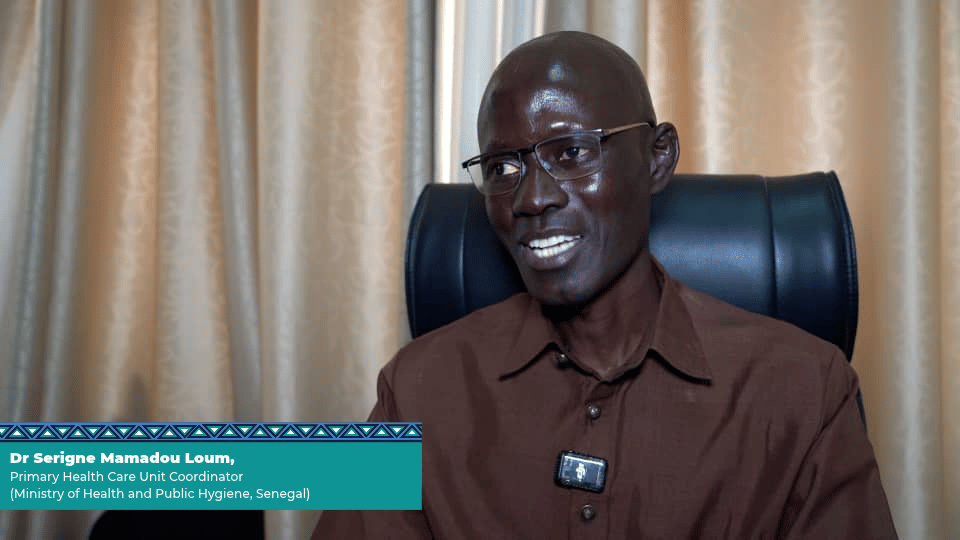
“The support was reinforcement of capacity to really assess the financing of community health….we assessed the financing of community health through a tool that FAH had designed, the CHFA tool. This really gave us a clearer picture on financing for community health.”
Dr Serigne Mamadou Loum, Primary Health Care Unit Coordinator (Ministry of Health and Public Hygiene, Senegal)
The financing assessment formed part of a wider government-led reform supported by FAH and partners. Through maturity assessments, investment mapping, strategic planning and a community health investment case, the Ministry gained a clearer view of where funding was reaching communities and where needs remained. The findings confirmed that resources were reaching the districts where community health is delivered, but also showed that stronger supervision, monitoring and learning are needed to turn these investments into consistent, quality services. This evidence is helping government consider not only how much is spent, but how financing can sustain quality over time.
A key result has been the institutionalization of community health maturity assessments. Senegal completed assessments in 2023, 2024 and 2025, with the national maturity score rising by 11%, from 2.08 out of 4 in 2024 to 2.31 in 2025. Yet the value of the process extends beyond the score. The first assessment produced a prioritised action plan, while subsequent rounds tracked progress and updated actions and targets for 2026–2027. Government now has a routine way to review what has changed, identify what still needs attention and guide next steps. Dr Serigne Mamadou Loum describes how this has strengthened the Ministry’s planning:
“The main activities that the PHC Cell has benefited from FAH include support to assess the maturity of community health in 2023, 2024 and 2025. This assessment was translated into an assessment report and an action plan. This evaluation of maturity also allows us to improve and plan community health better.”
Dr Serigne Mamadou Loum, Primary Health Care Unit Coordinator (Ministry of Health and Public Hygiene, Senegal)
Together, the CHFA and maturity assessments gave government a stronger evidence base for decision-making. By making financing needs, system bottlenecks and implementation priorities visible, they laid the foundation for translating evidence into a national community health strategy, costed workplan and investment case.
Making community health a national investment priority
Community health in Senegal is increasingly positioned not only as a way of delivering services but as a national planning and financing priority. The evidence did more than reveal gaps; it shaped what government could do next. With technical support from FAH and partners, Senegal finalised the Community Health Strategy 2025–2029. Building on lessons from the previous strategy and shaped through broad stakeholder consultation, it anchors community health more firmly within primary healthcare and universal health coverage. It also responds to priorities identified through analyses conducted with FAH: formalising community health worker roles, improving coordination, strengthening domestic financing, embedding gender equity and aligning budgets with community health priorities.
FAH has continued to provide technical support to turn these ambitions into practical financing and implementation tools. Senegal adopted a US$7.5 million costed operational plan for 2026 and is advancing its Community Health Investment Case. The operational plan sets an annual roadmap for implementing the strategy, while the investment case frames priorities in financing terms by estimating resource needs, assessing potential returns on investment and identifying the remaining funding gap. Together, these tools show government and partners what must be funded, coordinated and tracked.
Just as importantly, they give Government and partners a structured way to work together. A shared view of priorities, costs and financing gaps provides a stronger basis for aligning support behind one national reform agenda rather than separate projects. As Mr. Tidiane Gueye explains, this shared direction is critical to the reform’s success:
“Community health cannot progress if each actor works in isolation; coordination is now an essential factor for the success of the reform.” “FAH plays a facilitating role that allows the various actors to work towards a shared vision and the same national priorities.”
Mr. Tidiane Gueye; Technical Advisor to the Minister of Health and Public Hygiene
For Aissatou Diallo Fall, Health Economist at the Directorate of Planning, Research and Statistics (Ministry of Health and Public Hygiene, Senegal), making community-led PHC a Ministry priority creates opportunities to mobilise domestic and external resources and rally partners around Senegal’s Community Health Strategic Plan. This alignment is essential for coordinated action and continued investment in community health.
From analysis to investment
The reforms are still underway, but they are already translating into tangible budget commitments. The clearest signal is the government’s 2026 allocation of 26 billion CFA francs, roughly 46 million US dollars, for community health worker motivation. Behind this commitment are community health workers like Awa*. Before sunrise, she may prepare food for her own children, remind the eldest to help the younger ones get ready, and then set out on foot to reach another family’s door. Neighbours know her as someone who listens without rushing, notices when a mother is holding back a worry, and returns to check whether a sick child reached the health facility. She sits with frightened parents, examines children burning with fever, identifies suspected malaria cases and follows up so that no child needing urgent care is lost between household and facility. Balancing care for her own family with service to others, Awa* carries private worries too: whether there will be enough for school costs, whether her children are safe while she is away, and how long she can keep serving without reliable incentives. She persists because families trust her and because she has seen how timely advice or referral can change the course of a child’s illness. The allocation reflects a broader government commitment that evidence and reform processes supported by FAH helped inform and strengthen. It also addresses the long-standing challenge of community health workers delivering essential services, often as volunteers without reliable incentives. It is an important milestone, but financing needs remain, as many community health actors still serve on a voluntary basis. As Mr. Tidiane Gueye explains, sustaining this work means planning for continuity:
“We all know that a volunteer may have results, but they are not permanent.”
he says.
For government, the priority is therefore not only to finance immediate activities, but to build a system that can sustain community health over time:
“Today, the issue is no longer simply about funding activities, but about building sustainable funding for community health.”
Gueye says
This is where continued partner investment can be catalytic: helping government mobilise more domestic funding, coordinate resources, strengthen its capacity to manage and track implementation, and build a professional community health workforce that can sustain essential services. The goal is not only more funding, but funding that is predictable, well directed and reaches the frontline, so that community health workers like Awa* can keep serving the families who depend on them.